
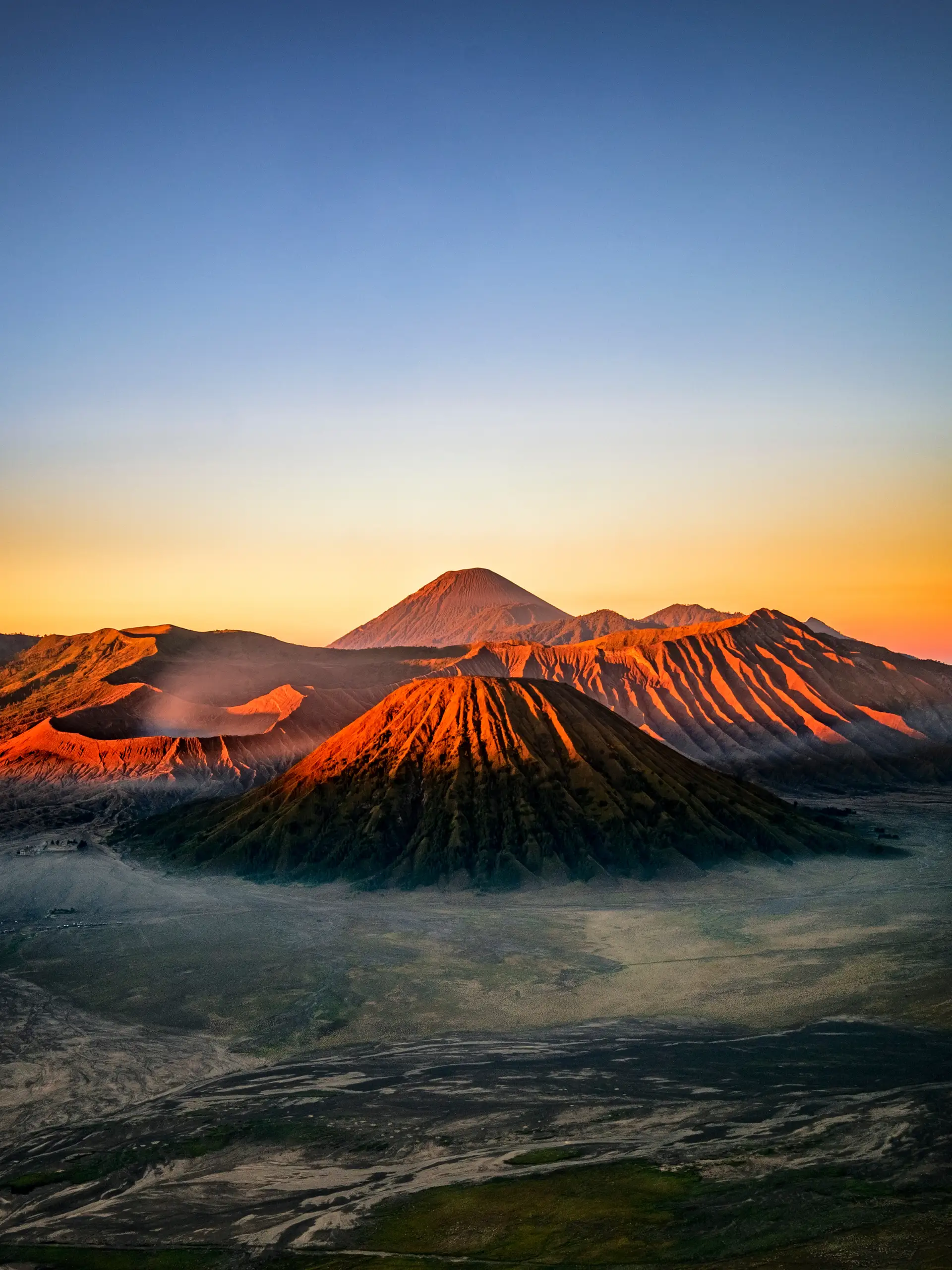
Indonesia is located on the Ring of Fire, home to over 120 active volcanoes, making it one of the most volcanically active regions on the planet. For travelers and photography enthusiasts, these peaks offer some of the most dramatic and ethereal landscapes in the world.
1. Mount Bromo (East Java)
Mount Bromo is perhaps Indonesia’s most iconic volcano. It sits inside the massive Tengger caldera, surrounded by a vast “Sea of Sand”.
- The Experience: Most visitors hike to the rim of the active crater to hear the roar of the earth and witness the sulfurous smoke rising from the depths.
- The Iconic View: A pre-dawn trek to Mount Penanjakan offers the classic sunrise view of Bromo, Mount Batok, and the distant, erupting Mount Semeru emerging from a blanket of morning mist.
2. Mount Ijen (East Java)
Famous for its “Blue Fire,” Mount Ijen offers a surreal nighttime spectacle that looks like something out of a science fiction movie.
- The Blue Fire: This rare phenomenon is caused by sulfuric gases emerging from cracks at high pressure and igniting when they hit the oxygen-rich air.
- The Acid Lake: At the summit lies a turquoise-colored crater lake, which is the largest highly acidic lake in the world.
- The Sulfur Miners: You will often encounter local miners carrying heavy baskets of solid sulfur up the steep crater walls.
3. Mount Rinjani (Lombok)
The second-highest volcano in Indonesia, Mount Rinjani is a premier destination for high-altitude trekking.
- Segara Anak: Inside the massive 6km-wide caldera is a stunning crescent-shaped lake called Segara Anak.
- Gunung Baru Jari: Rising from the center of the lake is a smaller, active sub-cone known as “the child of Rinjani,” which frequently emits plumes of ash.
- Spiritual Significance: The mountain is considered sacred by the Sasak and Balinese people, who often perform rituals and leave offerings at the lake.
4. Mount Merapi (Central Java)
Merapi, meaning “Mountain of Fire,” is one of the most active and dangerous volcanoes in the world.
- Lava Tours: Visitors can take Jeep tours through fields and villages devastated by past eruptions.
- Museum Sisa Hartaku: A small, moving museum displaying melted household items, serving as a memorial to the 2010 eruption.
5. Mount Anak Krakatau (Sunda Strait)
The “Child of Krakatoa” emerged from the sea after the cataclysmic eruption of 1883. It is a young, restless volcano that continues to reshape the landscape.
- The Expedition: Visiting requires a boat journey from the coast of Java or Sumatra. You can hike on its charcoal-black slopes, largely devoid of vegetation due to constant activity.
Safety and Planning Guide
| Volcano | Difficulty | Best Time | Current Status Check |
|---|---|---|---|
| Bromo | Easy-Moderate | Apr – Oct | Check PVMBG alerts |
| Ijen | Moderate | Apr – Oct | Check for gas activity |
| Rinjani | Challenging | Apr – Dec | National Park website |
| Merapi | Varies | Year-round | Strict exclusion zones |
Tips for Volcano Chasers
- Respect Exclusion Zones: Volcanic activity can change in minutes. Always follow instructions from local rangers and government alerts.
- Gear Up: A high-quality respirator mask is essential for Ijen (sulfur fumes), and warm layers are needed for Bromo and Rinjani.
- Hire a Guide: Local guides are trained to read early signs of volcanic restlessness and ensure you stay on safe paths.